

Effective PSLE Science preparation gives your child the best chance of reaching their academic goals and avoids last‑minute panic. Starting in Primary Science Tuition 5 with targeted strategies builds deep understanding of scientific concepts over time, unlike rushed revision in P6 which often produces surface learning. Many students who delay preparation miss the opportunity to develop the skills needed for confident performance in science exams.
This guide offers practical PSLE science revision tips from a former PSLE marker who knows what examiners look for. You’ll find strategies to improve understanding, structure answers for maximum marks, and approach practice papers with confidence.
See How Our Methods Deliver Results
What is PSLE Science Preparation Strategies and Why Should Students Start Early?
PSLE Science preparation is the structured process of learning core scientific concepts, practising PSLE question formats, and developing answering techniques aligned with PSLE marking standards.
Starting early helps students move beyond memorisation. Instead, they learn to apply scientific reasoning, which is a critical component of the PSLE Science examination.
According to Singapore’s Ministry of Education, PSLE Science focuses on application of concepts, data interpretation, and explanation skills rather than simple recall.
Source: https://www.moe.gov.sg
Students who begin PSLE Science preparation during Primary 5 often develop stronger confidence when handling open ended questions.
Many parents support their children through primary science tuition Singapore programmes that reinforce conceptual understanding and structured answering methods.
Start Your Child’s PSLE Science Preparation
Why Do Many Students Struggle With PSLE Science?
Many Primary 5 students find Science manageable at first. Challenges usually appear when questions require deeper explanation.
This means students must explain why something happens, not just state the answer.
Common difficulties include:
- Misunderstanding key scientific concepts
- Weak answering techniques
- Difficulty analysing diagrams or experimental setups
- Lack of exposure to PSLE style questions
Structured PSLE Science preparation helps students gradually build these skills before the final examination year.
Parents frequently turn to primary science tuition programmes in Singapore that provide systematic exposure to these question types.
Learn About Building Strong PSLE Foundations
What Should Primary 5 Students Focus On For PSLE Science Strategies?
Primary 5 is the ideal time to build strong foundations. The following are the Step by Step PSLE Science Preparation for P5 Students
1. Master Core Concepts
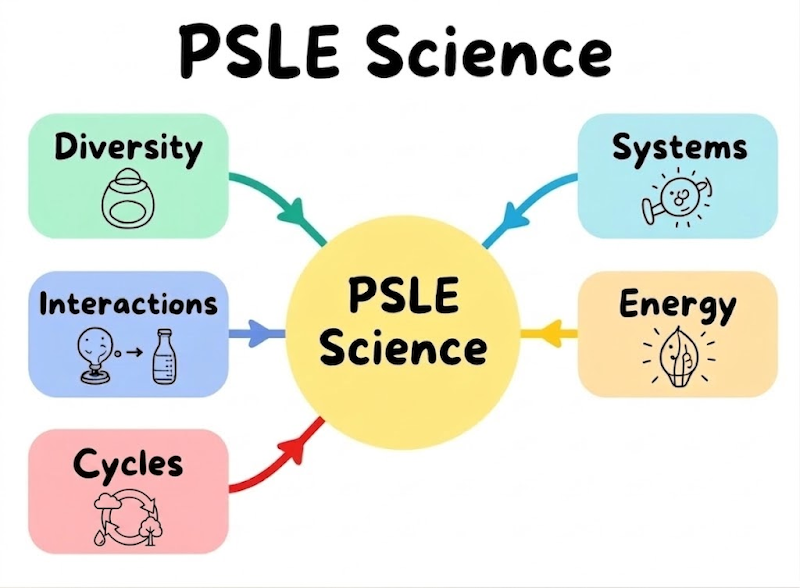
The PSLE science syllabus is organised around six key themes that form the basis of most questions: diversity, cycles, systems, interactions, energy. Mastery of these themes requires both factual knowledge and the ability to apply scientific concepts to unfamiliar situations.
Key PSLE Science Topics
- ✅ Diversity: identify and classify organisms; explain one adaptation
- ✅ Cycles: explain evaporation, condensation, precipitation; life‑cycle stages
- ✅ Systems: state component roles and how they interact (plant/human/electric)
- ✅ Interactions: describe forces, friction, magnet behaviour and light changes
- ✅ Energy: name energy forms and describe simple conversions (e.g. light → chemical)
PSLE science questions assess application as much as recall. Practise with past papers that require applying the science syllabus to new scenarios as this skill separates students who merely memorise facts from those who achieve top marks.
Discover Proven PSLE Science Strategies
2. Develop Strong Scientific Vocabulary
Precise wording earns marks. Help your child build topic‑by‑topic vocabulary lists and practice using the exact terms in sentences. For example, instead of “the plant makes food,” teach “the plant uses sunlight for photosynthesis to make glucose.”
Weak Answer Example
Question:❓ Explain why puddles disappear on hot days.
Poor Answer: 🚫“The water goes away because it’s hot and the sun makes it dry up.”
Strong Answer Example
Question:❓ Explain why puddles disappear on hot days.
Strong Answer:✅ “The water in the puddle evaporates. Heat energy from the sun causes the liquid water to change into water vapour (gas), which rises into air.”
Develop Essential PSLE Vocabulary
What Should Primary 6 Students Focus On During PSLE Science Preparation?

Primary 6 shifts focus from learning new topics to intensive revision, targeted practice and exam technique. Students who built solid foundations in P5 should now refine answering skills, close remaining gaps and practise under realistic conditions to maximise marks.
1. Develop Consistent Revision Habits
✅ Create a weekly timetable: 45‑minute focused sessions with short breaks; rotate topics so weaker areas get extra time while stronger topics receive brief maintenance reviews.
✅ Include at least one full practice paper weekly to expose gaps and improve pacing
✅ Use short, frequent reviews (spaced repetition) rather than marathon study to retain facts and concepts
2. Understanding PSLE Science Marking Schemes
Knowing expected answer depth helps you give the right amount of detail. Treat the mark allocation as a planning tool: one point per mark, and avoid repeating the same idea to fill marks.
| Mark Allocation | What to write | Example | Common mistake |
| 1 mark | Single term or identification | Name the process: evaporation | Over‑explaining when only term needed |
| 2 marks | Two distinct points / brief reason | State two conditions for plant growth: light and water | Giving only one point or repeating similar points |
| Mark Allocation”>4 marks | Four separate points or a clear multi‑step explanation | Describe water cycle: evaporation → condensation → precipitation → collection | Missing a key stage or vague wording |
3. Mastering Different Question Types
- Multiple choice: use option elimination and read all choices before selecting.
- Open‑ended: plan points first (one point per mark), use precise scientific vocabulary and link cause→effect.
- Data/graph questions: state observations, describe trends, then explain reasons (observation → interpretation → conclusion).
Master PSLE Examination Techniques
Quick template for a 4‑mark explanation:
- state the process or factor,
- give a reason
- provide a consequence or example
- conclude with a linking sentence using correct terminology.
4. Time Management During Examinations
Pacing matters more than perfection. A practical guideline is approximately one minute per mark. Use this to allocate time in the paper and return to check answers if time allows. Regular timed practice builds this skill and reduces exam anxiety.
Effective PSLE Science Revision Tips That Actually Work
Not all revisions are equal. The most effective PSLE science revision focuses on active learning and retrieval practice rather than passive rereading or highlighting. These methods build durable understanding and improve application in exam questions.
Active Recall Over Passive Reading
Test yourself rather than re-read. Create short practice questions from notes and try to answer them without looking. This reveals real gaps in knowledge. Example: make 20 flashcards on the water cycle (term on one side, brief explanation on the other) and practise until you can recall each clearly.
- How to implement:⚙️ write question prompts, attempt answers, then check and correct immediately.
- Benefit:💡 forces retrieval, strengthens memory pathways and highlights areas needing revision.
Develop Effective Revision Habits
Spaced Repetition for Long-Term Retention
Schedule reviews at increasing intervals to lock facts into long‑term memory: 1 day, 3 days, 1 week, 2 weeks. A simple revision calendar or digital flashcard app with spaced repetition settings automates this process.
- How to implement:⚙️ log the first study date for each topic and set the next review dates accordingly.
- Benefit:💡 reduces forgetting compared with massed, last‑minute cramming.
Teach Others to Deepen Understanding
Explaining concepts aloud reveals gaps quickly. Ask your child to teach a parent or sibling a topic in simple terms. If they can explain photosynthesis or the water cycle clearly, their understanding is strong. Preparing a one‑page “mini lesson” for each topic is a highly effective activity.
Practice Papers Under Realistic Conditions
Completing practice papers under exam conditions is essential. Treat these sessions as diagnostic: time the paper, use only allowed materials and simulate the exam environment to build stamina and pacing skills.
- How to implement:⚙️ schedule regular timed papers (start monthly, increase frequency closer to the exam) and always spend equal or more time reviewing mistakes afterwards.
- Benefit:💡 familiarises students with question formats, improves time management and converts errors into learning opportunities

How Parents Can Support PSLE Science Preparation At Home
Parents play an important role in supporting their child’s learning journey.
Helpful strategies include:
✅ Encouraging curiosity about everyday science
✅ Reviewing science concepts together
✅ Creating a weekly revision schedule
✅ Reinforcing effective PSLE science revision tips
Combining home support with structured guidance from P6 science tuition Singapore programmes often produces the best results.
Why Many Parents Choose Bestminds Academy
Bestminds Academy focuses on helping students build strong conceptual understanding and structured answering skills.
Students learn under the guidance of Mr Daniel Tay, a former PSLE marker and former MOE teacher with 12 years of teaching experience.
His experience provides valuable insight into:
- PSLE marking schemes
- Common student mistakes
- Effective answering frameworks
This expertise helps students strengthen their PSLE Science preparation and work towards achieving an AL1 score.
Parents seeking PSLE science tuition Singapore often value this level of examination insight.
FAQ Section
1. When should students start PSLE Science preparation?
Students should ideally start PSLE Science preparation in Primary 5. Early preparation builds conceptual understanding and allows sufficient time to practise PSLE style questions.
2. Is PSLE Science difficult for Primary 6 students?
The difficulty often comes from open ended questions requiring explanation. Consistent practice and strong conceptual understanding make the subject more manageable.
3. What are the best PSLE science revision tips?
Effective PSLE science revision tips include practising explanation questions, analysing diagrams, reviewing mistakes, and maintaining consistent weekly revision.
4. Does PSLE science tuition help students score better?
Structured PSLE science tuition Singapore programmes help students practise exam questions regularly and understand examiner expectations.
Start Your Child’s PSLE Science Preparation With Bestminds Academy
If you are looking for effective PSLE science tuition in Singapore to support your child’s learning journey, Bestminds Academy provides structured guidance designed to help students master PSLE answering techniques and strengthen scientific understanding.
Under the guidance of Mr Daniel Tay, students gain insights into how PSLE answers are evaluated and how to approach challenging science questions with confidence.
📞Contact Bestminds Academy Today
Visit https://bestmindsacad.com to learn more about our PSLE Science programme and how we support students in achieving strong academic results.
🔍 See Our Programs
🧠 Learn Our Methodologies
📚 Read Our Blogs
🏫 Learn About Us
📧 Email: admin@bestmindsacad.com
📱 Call: +65 9365 1228
📍 Address: 170 Upper Bukit Timah Road, Bukit Timah Shopping Centre, #B2-13B, Singapore 588179
🌐 Website: https://bestmindsacad.com
Limited spaces available for our Primary 5 and 6 programmes. Secure your child’s place now.
