
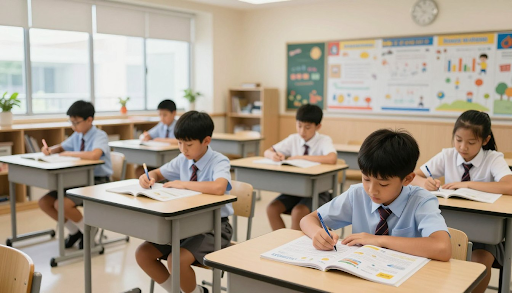
Many Primary 6 students in Singapore spend months memorising textbook definitions. They highlight thick stacks of notes and complete endless stacks of top school assessment books. Yet, when preliminary exam papers or final school results return, their grades do not reflect their intense effort. Simple rote learning completely fails when final test papers demand deep analytical application rather than basic fact recall.
To stop losing critical marks, your child must look past basic content memorisation. Securing top grades requires a deep understanding of hidden experimental variables. It demands the consistent use of precise, structured answering writing frameworks. Enrolling in a highly specialised P6 science tuition programme in Singapore bridges this performance gap. It transforms your child’s raw topic knowledge into beautifully structured, high-scoring exam scripts.
The Diagnostic Reality: Why Textbook Mastery Fails in P6 Science Exam Preparation
Traditional, passive revision methods break down quickly when faced with the modern Singapore primary science syllabus. Many parents assume that buying more assessment books is the ultimate answer to effective P6 science exam preparation. However, doing papers without a clear, systematic strategy only reinforces bad habits. The actual PSLE paper does not simply ask students to list facts or regurgitate definitions. Instead, it places familiar core concepts inside entirely unfamiliar, real-world scenarios.
Students who encounter a textbook fact in an unfamiliar exam scenario often experience sudden cognitive overload. Without a clear application strategy, freezing up becomes the default response.
When a child encounters a strange experimental setup or an unfamiliar animal adaptation while preparing for the independent P6 science exam, they often experience sudden cognitive overload. Exam anxiety combines with weak logic structures, causing bright students to completely freeze up.
Educational studies show that students taught using inquiry-based methods consistently outperform those who rely strictly on rote learning. The national syllabus requires students to think like real scientists. They must look at a novel problem, identify the underlying scientific theme, and accurately predict outcomes based on given data patterns.
The Hidden Trap of Topic Interaction
A major hurdle in advanced preparation is the interaction between different scientific topics. Exam questions regularly combine discrete themes, such as linking the physical properties of materials with electrical conductivity or thermal energy transfer.
- The Component Blindspot: A student might perfectly explain a standalone circuit.
- The Application Test: That same student struggles when the circuit includes a thermal bimetallic strip that bends when heated.
- The Solution: Effective revision must step away from isolated chapter reviews. It must intentionally push students to solve cross-topic problems that mimic actual exam papers.
Real Scenario: The Closed Circuit Paradox
Consider how a standard assessment problem turns tricky. A student memorises that a closed circuit allows electricity to flow. The exam then presents a diagram where a bulb does not light up, even though all wires appear connected.
- The student must look beyond the obvious layout.
- They must check for hidden insulating materials or opposing battery placements.
- They must isolate why the current cannot flow through that specific configuration.
Without explicit training in structural analysis, the student defaults to generic answers. They write that the bulb is simply fused, missing the actual structural flaw entirely.
Hidden Mark Deficits: The Most Common PSLE Science Mistakes in Booklet B

Many hardworking Primary 6 students fall victim to predictable, repetitive errors in Booklet B. Missing out on top academic bands rarely stems from a total lack of basic topic knowledge. Instead, it happens because of specific, structural execution errors that wipe out marks instantly.
Here are the most common PSLE science mistakes that cost students precious marks:
- Using Everyday Language: Students write casual descriptions instead of using precise scientific vocabulary.
- The Incomplete Comparison Trap: Forgetting to mention both experimental setups when a question explicitly asks them to “compare” results.
- Misidentifying Crucial Variables: Failing to isolate the single independent changed variable from the constant variables in an experiment.
- Vague Cause-and-Effect Links: Stating an outcome without clearly identifying the scientific catalyst that caused it.
Comprehensive Diagnostic Checklist for Parents
Use this quick analytical guide to review your child’s recent exam papers and identify exactly where marks are being lost:
- Does the answer skip over the numerical data provided in accompanying tables?
- Did the student use the word “air” when the question specifically required “water vapour”?
- Is the conclusion a simple restatement of the question instead of a scientific explanation?
- Did they fail to mention the constant variables needed to ensure a fair test?
Identifying these structural blind spots early allows for targeted intervention before major examinations arrive.
Structural Precision: Advanced PSLE Science Answering Techniques for Booklet B

To secure full marks in the highly challenging open-ended section, students must use structured writing frameworks. Examiners use strict, non-negotiable marking keys. Using systematic psle science answering techniques ensures your child ticks every single box on that marking guide.
Answering Technique Strategy | Core Working Mechanism | Target Academic Outcome |
The CER Framework | State a clear Claim, provide literal Evidence, and apply scientific Reasoning. | Eliminates vague, rambling answers. |
The 3C Principle | Identify the core Concept, anchor it to the Context, and write with total Clarity. | Prevents student panic with novel questions. |
The OAC Method | Observe trends, Analyse variables, Communicate with keywords. | Decodes complex tables and line graphs. |
When your child masters these specialized psle science answering techniques, they stop guessing what the question wants. They learn to view every question through the eyes of an exam marker. This structural clarity transforms ambiguous paragraphs into precise, undeniable, full-mark responses.
The Mechanics of the OAC Method in Complex Data Analysis
When faced with intricate line graphs tracking multiple variables simultaneously, students often panic. The Observe-Analyse-Communicate (OAC) method provides a calm, systematic pathway through the data.
- Observe: Identify the overall trend of the lines, do they rise, fall, or remain constant?
- Analyse: Connect the shifts in the graph directly to the changing independent variable.
- Communicate: Draft the final response using strict scientific vocabulary, ignoring casual conversational descriptions.
This systematic approach prevents students from misinterpreting trends and ensures their written analysis remains completely accurate.
The Elite Strategy: A Step-by-Step Blueprint on How to Score AL1 Science

Reaching the highest academic band requires a strategic shift from passive reading to aggressive problem-solving. Knowing how to score AL1 science is not an innate talent. It is a highly repeatable skill developed through targeted training.
Follow this exact four-phase blueprint to elevate your child’s score profile:
- Analyse the Command Stem: Circle words like “Explain”, “State”, or “Compare” to understand the required answer depth.
- Underline Critical Experimental Data: Highlight changed conditions, numeric values, and hidden textual clues.
- Inject Technical Keyword Phrases: Intentionally weave terms like exposed surface area, rate of heat loss, or rate of photosynthesis into the final draft.
- Execute the 7-Step Accuracy Protocol: Double-check that all variables are correctly matched and that no conversational language slipped into the text.
Learning how to score AL1 in science gives students a massive psychological edge. It replaces nervous guessing with calm, systematic execution during high-pressure national examinations.
Master-Level Data Interpretation: Reading Between the Lines
AL1 candidates look at experimental charts differently from the average student. They do not just read the surface numbers; they look for anomalies, saturation points, and immediate structural shifts.
- The Saturation Plateau: In a graph showing photosynthesis vs carbon dioxide levels, they spot where the line flattens out.
- The Scientific Conclusion: They deduce that another factor, like light intensity or temperature, has become the limiting variable.
- The Exam Edge: This deep insight allows them to answer advanced follow-up questions that completely baffle other students.
Teaching your child to look for these subtle data inflection points is a core pillar of high-tier exam preparation.
Time Optimization and Stress Management Tactics
Achieving an AL1 grade requires supreme efficiency under tight examination room conditions. Students must allocate their time strictly across both booklets to avoid rushing the open-ended questions.
- Booklet A Strategy (approximately 40 minutes): Complete the multiple-choice section efficiently, leaving ample time for complex application problems.
- Booklet B Strategy (approximately 55 minutes): Dedicate significant focus to formatting clear, structured responses for high-weightage questions.
- The Review Cycle (approximately 10 minutes): Save the final ten minutes exclusively for running the 7-Step Accuracy Protocol to catch sneaky, careless slips.
By mastering this precise pacing strategy, students maintain absolute focus and emotional control throughout the entire examination.
Protect Your Child’s Hard Work with Expert P6 Science Tuition Singapore
Hard work alone won’t secure top PSLE results. Deep conceptual understanding and proven exam techniques are equally critical. Leaving preparation to chance risks missed goals and lost opportunities.
Bestminds Academy’s P6 Science Tuition programme eliminates the guesswork. Led by Mr. Daniel Tay, a former MOE teacher and PSLE Science marker, our curriculum pinpoints weak spots and replaces bad habits with structured frameworks like the CER and 3C methods.
Classes run via ClassIn, our interactive online platform, combining targeted group instruction with collaborative problem-solving and home review tools to reinforce learning between sessions.
Don’t let vague answers or missing keywords block your child’s path to their dream secondary school. Book a diagnostic assessment with Bestminds Academy today.
🔍 See Our Programs
🧠 Learn Our Methodologies
📚 Read Our Blogs
🏫 Learn About Us
📞 Contact Bestminds Academy
📧 Email: admin@bestmindsacad.com
📱 Call: +65 9365 1228
📍 Address: 170 Upper Bukit Timah Road, Bukit Timah Shopping Centre, #B2-13B, Singapore 588179
🌐 Website: https://bestmindsacad.com
Limited spaces available for Primary 5 and 6 students. Secure your child’s place with Singapore’s leading primary science specialist now!
