

Your child is in Primary 6. The PSLE Science exam feels closer than ever. Understanding the most important Primary 6 Science topics can guide your revision strategy and help your child feel prepared. Not all topics carry equal weight in the PSLE exam. Some topics appear repeatedly across multiple sections of the paper, whilst others are tested less frequently.
This guide identifies the six core topics that dominate PSLE Science papers based on real exam patterns. Mastering these topics builds the foundation your child needs to perform confidently on exam day. These aren’t just suggestions; they’re the areas where examiners consistently ask questions and where strong understanding separates higher-scoring students from the rest.
Key Takeaways
- Systems in Organisms appear in 25-30% of PSLE papers
- Cycles (Carbon and Water) are concept-heavy and tested frequently
- Electricity is a high-mark question area requiring practical understanding
- Forces and Simple Machines test problem-solving skills
- Cells and Living Things form foundational knowledge
- Consistent revision of these topics builds exam readiness and confidence
Topic #1: Systems in Organisms (Circulatory and Respiratory Systems)
This is the most frequently tested topic in Primary 6 Science for PSLE. Your child learns how the human body works as an interconnected system. The circulatory system delivers oxygen and nutrients. The respiratory system brings oxygen into the body. Examiners test understanding of how these systems connect and support each other.
Why it matters:
Students need to understand function, not just memorise structure. The exam asks “Why does the heart pump faster during exercise?” not just “What does the heart do?” Your child must explain relationships between body systems.
Real PSLE focus:
Open-ended questions often ask about how one system supports another. For example: “Explain how the circulatory system helps the respiratory system work effectively.” This requires deeper understanding.
Common mistakes:
- Memorising heart parts without understanding function
- Not explaining how oxygen gets from lungs to cells
- Confusing arteries and veins roles
What parents should know:
Your child learns this through diagrams, labelling, and explanations. Encourage them to draw systems and label arrows showing how blood and oxygen move. Ask “Why?” questions: “Why does blood need oxygen? Where does it go?” This type of questioning mirrors how PSLE examiners assess understanding. Strong revision requires asking students to explain the “why,” not just the “what.” This type of Primary 6 Science revision approach builds deeper comprehension that examiners reward.
Topic #2: Photosynthesis and Plant Nutrition
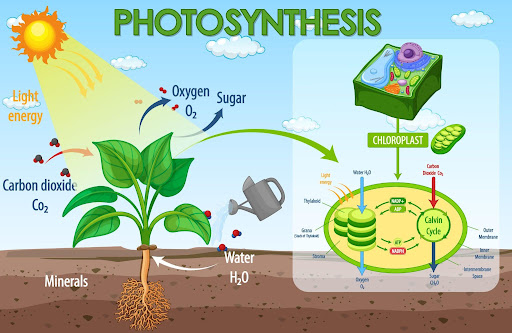
Primary 6 Science revision often focuses on how plants make their own food. This is a complex concept that requires students to understand inputs (sunlight, water, carbon dioxide) and outputs (glucose, oxygen).
Why it matters:
Photosynthesis is foundational to understanding ecosystems. Students need to grasp that plants are producers. They convert light energy into chemical energy (food). This concept links to food chains, energy flow, and the carbon cycle.
Real PSLE focus:
Examiners test whether students understand the purpose of photosynthesis, not just the word. Questions ask: “Why do plants need sunlight?” The answer isn’t “Because they do.” It’s “Because light energy is needed to convert carbon dioxide and water into glucose.”
Common mistakes:
- Confusing photosynthesis with respiration
- Not identifying the exact inputs or outputs
- Failing to explain the energy transformation
What parents should know:
Use real-world connections. Relate photosynthesis to plant health. A plant near a window grows faster because it has more light. A plant in a dark corner struggles. This helps your child see why light matters.
Topic #3: The Carbon Cycle
The carbon cycle is one of the most important Primary 6 Science topics for PSLE because it integrates multiple concepts. Students learn how carbon moves through the environment via photosynthesis, respiration, decomposition, and combustion.
Why it matters:
This topic tests systems thinking. Students must understand how processes connect. Carbon doesn’t just disappear. It cycles continuously. Understanding this cycle prepares students for secondary science topics like climate change and energy flow.
Real PSLE focus:
Examiners ask students to identify each process in the cycle and explain carbon movement. A typical question: “Describe how carbon from the atmosphere enters plants and returns to the atmosphere.” Your child must mention photosynthesis, respiration, and decomposition.
Common mistakes:
- Listing processes without explaining carbon movement
- Not understanding that respiration releases carbon dioxide
- Forgetting decomposition as a key process
What parents should know:
Have your child draw the carbon cycle repeatedly. Each time, encourage them to label what happens at each stage. Ask: “Where does carbon go here? How does it get there?” Repetition builds understanding.
Topic #4: The Water Cycle
The water cycle is tested in both multiple-choice and open-ended questions. It appears in PSLE Science preparation materials frequently because it’s practical and observable.
Why it matters:
Students see the water cycle in nature daily. Rain falls. Water evaporates. Clouds form. This real-world connection helps understanding, but students must still learn precise definitions.
Real PSLE focus:
Examiners test whether students understand each process: evaporation (water becomes gas), condensation (gas becomes liquid), and precipitation (water falls). Questions ask students to explain why clothes dry faster on a hot, windy day.
Common mistakes:
- Confusing evaporation and condensation
- Not identifying the energy source (sun’s heat)
- Not explaining why precipitation occurs
What parents should know:
Use everyday examples. Watch steam rise from hot water (evaporation). Watch droplets form on a cold mirror (condensation). Ask your child to explain each process using these examples.
Topic #5: Electricity and Circuits
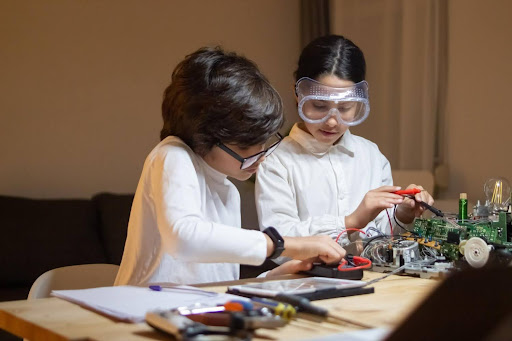
Electricity is consistently tested because it requires both knowledge and practical understanding essential for PSLE Science preparation. Students must know circuit components and predict how changes affect brightness.
Why it matters:
This topic tests problem-solving. Students need to understand cause and effect. If you add a bulb to a circuit, what happens to brightness? Why? The answer requires understanding how electricity flows and energy is distributed.
Real PSLE focus:
Examiners ask students to draw circuits, identify components, predict circuit behaviour, and explain why changes happen. A series circuit versus a parallel circuit produces different results. Your child must explain why.
Common mistakes:
- Drawing circuit diagrams incorrectly
- Not understanding brightness depends on how electricity distributes
- Confusing series and parallel circuits
What parents should know:
Encourage your child to experiment. Build circuits using batteries, wires, bulbs, and switches. Predict what happens. Test it. Discuss why predictions were correct or incorrect. Hands-on learning builds deep understanding.
Topic #6: Forces and Simple Machines
Forces and Simple Machines complete the most important Primary 6 Science topics list. This topic requires understanding how pushes and pulls work and how machines make work easier.
Why it matters:
Students learn how forces cause movement and change. They understand that levers, pulleys, and inclined planes reduce effort needed. This connects to real-world applications from opening doors to lifting heavy objects.
Real PSLE focus:
Examiners test whether students understand force relationships and machine advantages. A typical question asks: “How does a pulley help lift a load?” The answer must explain how pulleys change direction or distribute weight.
Common mistakes:
- Knowing what machines do without explaining how
- Not identifying effort and load correctly
- Failing to explain why machines are useful
What parents should know:
Find machines around your home. A door handle is a lever. Stairs are an inclined plane. Scissors are levers. Discuss how each makes work easier. Ask your child to explain the mechanism.
Why These Topics Matter for PSLE
These six topics are the foundation of MOE Science syllabus assessment. Examiners test them because they’re essential to secondary science. They also integrate concepts across multiple areas. For example, photosynthesis connects to the carbon cycle, which connects to ecosystems.
Your child must demonstrate both knowledge and application. They need to explain not just what happens, but why it happens. This is what separates strong answers from weak ones in PSLE Science exam success.
How to Help Your Child Revise These Topics
Start early: Begin revision in P6, not just before exams. Spreading revision over months builds deeper understanding.
Mix learning styles:
- Watch educational videos explaining concepts
- Draw diagrams and label them
- Conduct simple experiments
- Write notes in their own words
- Discuss concepts out loud
Test understanding: Ask “Why?” and “How?” questions, not just “What?”
Practise past papers: Focus on questions from these six topics. This shows your child what examiners ask.
Encourage mistakes: Learning from errors builds deeper understanding than getting everything right.
Create concept maps: Show how topics connect. Systems support each other. Cycles repeat. Energy flows through ecosystems.
Use real-world connections: Relate topics to daily life. Why does your child’s hair get wet in the rain? (Water cycle.) Why do muscles feel tired after exercise? (Respiration increases.)
